


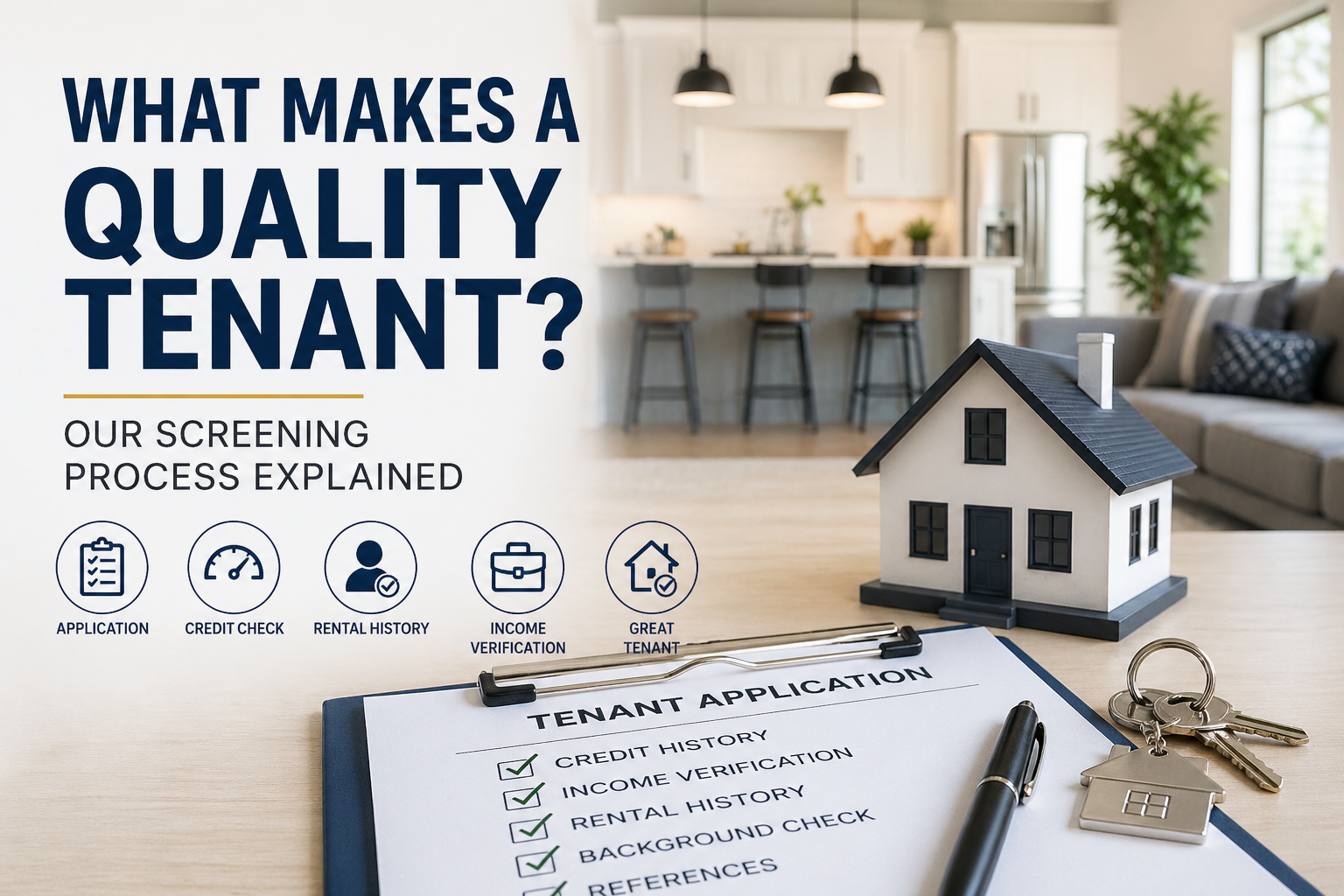
A Practical Guide for Property Owners Who Want Stable Income, Fewer Headaches, and Long-Term Value
By Property Management Team | Residential Leasing & Asset Management
In real estate, cash flow is only as strong as the person paying the rent. A beautiful property, a strong market, and competitive pricing can still underperform if the tenant is a poor fit. On the other hand, a well-screened resident can turn an average rental into a predictable, low-stress asset that performs year after year.
Owners often ask a simple question: what actually makes a “quality tenant”? It’s not just a high credit score or a steady job. It’s a combination of financial reliability, behavioral consistency, and long-term compatibility with the property. Below is a transparent look at how we define quality, and the exact screening process we use to identify it.
Why Tenant Quality Matters More Than Rent Price
Many landlords focus heavily on maximizing rent. That’s understandable, but it can be shortsighted. A slightly higher monthly rent does not compensate for late payments, property damage, or early lease breaks.
A quality tenant typically delivers:
- Consistent, on-time payments
- Lower maintenance costs due to better care of the home
- Longer lease terms and reduced turnover
- Fewer disputes, complaints, or legal issues
Over a 2–3 year period, the difference between an average tenant and a strong tenant can represent thousands of dollars in net performance.
The Core Traits of a Quality Tenant
1. Financial Stability
A reliable income is the foundation. We look for tenants whose income comfortably supports rent, not just barely covers it. The industry standard is typically 2.5x to 3x the monthly rent, but we also evaluate stability of employment and consistency over time.
2. Payment History
Past behavior is one of the best predictors of future behavior. A tenant who has consistently paid rent on time in previous properties is far more likely to do the same moving forward.
3. Credit Profile
Credit is not about perfection. It’s about patterns. We look for responsible use of credit, manageable debt levels, and absence of serious delinquencies like collections, evictions, or recent charge-offs.
4. Rental History
We verify previous landlords to confirm lease compliance, property condition at move-out, and overall reliability. A tenant who respects the property and communicates well is far more valuable than one who simply qualifies financially.
5. Stability and Intent
Tenants who plan to stay longer reduce vacancy risk and turnover costs. We assess whether the applicant’s situation aligns with the lease term and the property itself.
6. Communication and Professionalism
From the first inquiry, we evaluate responsiveness, clarity, and respect. This often reflects how the tenant will handle maintenance requests, lease obligations, and general interaction during the tenancy.
Our Screening Process: Step by Step
A strong outcome requires a structured process. We don’t rely on one data point. We evaluate multiple layers to form a complete picture of each applicant.
Step 1: Pre-Screening Before Showings
Before scheduling a showing, we ask a short set of qualifying questions. This helps filter out applicants who clearly do not meet baseline criteria, saving time for both owners and serious renters.
- Move-in timeline
- Number of occupants
- Pets and relevant details
- General income range
This step reduces unnecessary traffic and ensures the property is shown to realistic candidates.
Step 2: Formal Application Submission
Every adult occupant must complete a full application. This includes identity verification, employment history, rental history, and financial disclosures.
Incomplete applications are not processed. This alone filters out a surprising number of unqualified applicants.
Step 3: Credit and Background Checks
We run a comprehensive screening report that includes:
- Credit score and full credit profile
- Collections, judgments, and bankruptcies
- Criminal background (where legally applicable)
- Eviction history
We evaluate the context behind the numbers, not just the score itself.
Step 4: Income and Employment Verification
We verify income through pay stubs, bank statements, or direct employer contact when necessary. For self-employed applicants, we review tax returns or consistent deposit history.
The goal is to confirm not just income level, but reliability and continuity.
Step 5: Rental History Verification
We contact previous landlords to confirm:
- On-time payment history
- Property condition at move-out
- Lease compliance
- Whether they would rent to the tenant again
This step often reveals insights that no credit report can provide.
Step 6: Holistic Evaluation
We don’t approve or deny based on a single metric. Instead, we weigh the full profile:
- Income vs rent ratio
- Credit trends, not just score
- Stability of employment
- Rental references
- Overall consistency of the application
Our goal is not just qualification, but fit.
Red Flags We Watch For
Just as important as identifying strong tenants is recognizing warning signs early.
- Inconsistent or unverifiable income
- Frequent job changes without clear explanation
- Gaps or inconsistencies in rental history
- Recent evictions or unpaid housing balances
- Poor communication or evasiveness during screening
One issue alone may not be disqualifying, but patterns matter. Multiple red flags significantly increase risk.
Balancing Fairness and Risk
Professional screening must always be consistent, objective, and compliant with fair housing laws. We apply the same criteria to every applicant and evaluate based on documented factors only.
At the same time, we understand that not every applicant fits a perfect mold. Our role is to balance opportunity with responsible risk management, ensuring owners are protected while maintaining fair access to housing.
How Strong Screening Protects Your Investment
A structured screening process directly impacts performance in three key ways:
1. Reduced Vacancy
Well-qualified tenants are more likely to complete their lease and renew, reducing turnover and marketing costs.
2. Lower Maintenance and Damage Costs
Tenants who take pride in their living space tend to report issues early and maintain the property properly.
3. Predictable Cash Flow
Reliable payments create stability, which is critical for long-term investment planning.
What Owners Should Expect From a Professional Screening Process
If you’re working with a property manager, transparency is key. You should expect:
- Clearly defined screening criteria
- Consistent application of those criteria
- Full documentation of the applicant’s profile
- A clear recommendation, not just raw data
Screening is not just administrative. It’s a critical decision point that affects the performance of your asset.
Final Thoughts
A quality tenant is not an accident. It’s the result of a disciplined, consistent screening process combined with market awareness and professional judgment.
In today’s rental market, where demand remains strong but expectations are rising, the difference between average and exceptional management often comes down to tenant selection.
If your goal is stable income, reduced stress, and long-term asset growth, investing in a thorough screening process is one of the most important decisions you can make.
Questions about leasing strategy, tenant placement, or optimizing your rental property performance? We’re here to help with clear guidance and a process built around protecting your investment.
Check out this article next